Accredited courses from leading Australian universities, TAFEs and colleges

Automotive Courses



About Automotive
Australia’s automotive sector has changed a lot since local car manufacturing closed down. Even so, it remains one of the country’s largest trade sectors. Workshops, dealerships and fleet operators all need skilled technicians. That need has only grown as cars pack in more sensors and onboard computers than ever before.
Most people enter the trade through an apprenticeship. You earn a wage while you train toward a Certificate III in Light Vehicle Mechanical Technology, learning engines, electrics and diagnostics under supervision. It’s a hands-on route that suits people who learn best by doing rather than sitting in a classroom.
Technicians ready to progress often study further. A Certificate IV in Automotive Mechanical Diagnosis sharpens fault-finding skills on late-model engines. A Diploma of Automotive Technology can lead to workshop leadership roles. PayScale’s 2026 research shows pay rising steadily as technicians add these extra skills.
Electric and hybrid cars are pushing the trade in a new direction. Technicians who learn battery safety and high-voltage checks are well placed as more of these cars reach Australian roads. You can study flexibly too, mixing on-the-job training with structured lessons at a pace that fits your life.
Average Salaries
Automotive workers may earn between $55000 and $135000 per year
According to SEEK’s 2026 career advice data, automotive technicians in Australia typically earn $80,000 to $90,000 a year. Entry-level mechanics tend to start closer to $55,000. Experienced workshop and service managers can earn well over $130,000 once they move into senior roles.
Career Outcomes
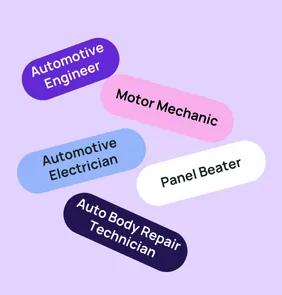
Graduates with an automotive qualification move into a wide range of hands-on roles across workshops, dealerships and fleet businesses. Because the trade is built around real experience, most people step straight into paid work once they finish their apprenticeship or certificate. Common positions to look for include working as a:















What do Automotive graduates do?
People working in the automotive trade keep cars, utes and trucks safe on the road. Their day-to-day work often includes:
- Checking, servicing and repairing cars, utes, trucks and motorbikes
- Finding faults using diagnostic tools
- Doing routine work such as oil changes, brake jobs and tyre checks
- Working on newer tech, such as hybrid and electric systems
- Talking customers through repairs, costs and vehicle care
- Running the workshop day-to-day and guiding apprentices in senior roles
Many people in this trade also move into parts or service advisor roles. They help customers work out what their car needs and why. Others build toward workshop management, running staff and daily jobs as their experience grows.
Is Automotive right for you?
People who thrive in the automotive trade tend to mix practical skill with real curiosity about how things work. Employers want technicians who stay calm under pressure and think a problem through, rather than guessing at a fix. Useful traits include:
- Strong mechanical skill and hands-on problem-solving
- Good grasp of vehicle systems and newer technology
- Close attention to detail and a safety-first mindset
- Clear communication skills for explaining repairs to customers
- Willingness to keep learning as vehicle technology moves on
- Physical stamina for standing, lifting and working in a busy workshop
- Basic business sense, especially for those hoping to run their own shop
- Ability to work well alone and as part of a team
Building these skills through a mix of study and real workshop time is usually what sets a sought-after technician apart from the rest.
Job opportunities
Automotive remains one of Australia’s steadiest trade sectors for finding work. Industry data reported to Jobs and Skills Australia shows motor mechanics are hard to find across much of the country. That means newly qualified technicians can often find steady work soon after finishing their trade.
Electric and hybrid cars are reshaping where growth sits within the trade. Technicians with battery safety and high-voltage skills are in growing demand. Demand also stays strong for traditional mechanical and diagnostic roles across dealerships and independent workshops.
Career growth tends to follow a clear path. Many technicians move from an apprenticeship into diagnostics or specialist work. From there, some step up into workshop supervision or open their own business as they build experience.
Frequently Asked Questions
FAQs
Why pursue automotive studies at an advanced or managerial level?
Advanced study can lead to a supervisor, workshop manager or diagnostics role. It mixes hands-on skill with people skills and business sense, which suits tradespeople ready for the next step.
Can automotive qualifications lead to business ownership?
Yes. Many trade-qualified mechanics use their skills and years on the tools to open their own garage or mobile repair service. Adding some business study to a trade certificate tends to boost your odds of success.
Is there a future in automotive with electric vehicles on the rise?
Definitely. The shift to electric cars is creating fresh demand for EV specialists. Techs who learn battery care and EV safety rules, an area the Australian energy department tracks closely, tend to stay in demand.
Which institutions offer nationally recognised automotive training?
TAFEs and training providers across Australia offer accredited certificate and diploma-level automotive courses. Comparing them by place, study mode and focus area makes it easier to find the right fit.


