Accredited courses from leading Australian universities, TAFEs and colleges


Qualification Level
Accredited courses from leading Australian universities, TAFEs and colleges



An MBA is a postgraduate degree for professionals who want senior leadership roles. Australian business schools build the degree around real business problems. They use case studies and group projects rather than pure theory. Full-time, part-time and executive study options mean the degree fits around an existing career. It does not need to replace one.
The curriculum usually covers strategy, finance, marketing and operations. Many programs let you specialise in areas such as entrepreneurship or international business. Programs accredited by the Association of MBAs or AACSB meet standards recognised around the world. That accreditation gives graduates real confidence in the quality of their degree.
Demand for skilled managers keeps growing across the Australian economy. Jobs and Skills Australia expects the Managers occupation group to grow by over 140,000 people by 2030. MBA graduates are well placed to fill many of these roles.
Graduates often move into consulting, corporate strategy or general management. Many use the degree to speed up a path to director-level roles. Businesses want leaders who can guide a team through change. An MBA remains one of the most direct routes to that kind of seniority.
MBA workers may earn between $60000 and $210000 per year
Australian MBA graduates earn an average base salary of AU$108,000 a year. Typical earnings range from around AU$58,000 to AU$221,000, depending on experience, industry and seniority (PayScale, 2026).
For broader context, full-time managers across Australia earn an average of $2,800.90 a week before tax, or roughly $145,600 a year (Australian Bureau of Statistics, May 2025). Jobs and Skills Australia projects the Managers occupation group to grow by 143,400 people by 2030. That growth supports continued demand for MBA-qualified leaders.
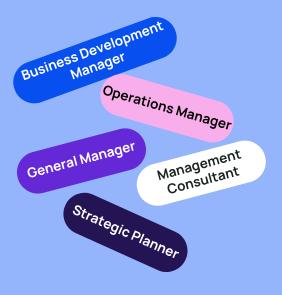
Finishing an MBA opens up a wide range of senior and strategic roles. Many graduates also use it as a springboard to start their own business. Common roles that MBA graduates move into include:
People who complete an MBA typically move into roles that shape the direction of a business, rather than just one part of it. Common responsibilities include:
Many MBA graduates step into general management or executive roles fairly soon after finishing. Employers see the degree as proof they can operate at that level. Others use the skills to launch or scale their own business, applying what they learned about finance and strategy directly to their own venture.
Whatever path they take, MBA graduates tend to be the people others turn to when a business needs clear thinking under pressure. That mix of confidence, structure and practical skill is exactly what the degree is designed to build.
An MBA suits people who already have some work experience and want to lead at a higher level. The degree rewards a particular mix of qualities, including:
If this sounds like you, an MBA can sharpen skills you already use every day. It also gives you the credibility to apply them at a more senior level.
Demand for skilled managers keeps rising across the Australian economy. Jobs and Skills Australia projects the Managers group to grow by 143,400 people by 2030. That is one of the strongest projected increases of any occupation group.
Full-time managers earn an average of $2,800.90 a week before tax (Australian Bureau of Statistics, May 2025). That is well above the all-occupations average. MBA graduates are well placed to compete for these roles, since the degree signals both technical knowledge and proven leadership.
Common destinations for MBA graduates include general manager, director of strategy, management consultant and chief executive roles. Many also move into consulting firms or start their own business. They use the degree’s broad grounding in finance and operations to support the move.
Graduates often move into top leadership, consulting or their own business. Common roles include general manager, director, chief executive and business strategist. An MBA can also help you switch industries or work overseas.
It is not a must, but many chief executives and senior bosses hold one. The degree builds skills in leadership, decision-making and running an organisation well. Those skills matter most at the top level.
An MBA focuses on cross-team leadership at a senior level. It usually expects several years of work first. A general master’s degree in management tends to suit early-career students. It focuses more on the basics of how a business runs. Pick the one that matches your own experience and goals.
Check that the school is registered with TEQSA, Australia’s higher education watchdog. Also weigh up rankings, past student outcomes, study mode and the majors on offer.
Yes, especially when a trusted school runs it and it holds proper accreditation. Online MBAs offer real flexibility. They often draw experienced students too, which makes group work just as useful as it is on campus.