Accredited courses from leading Australian universities, TAFEs and colleges

Youth Work Courses



Average Salaries
Career Outcomes
Graduating
Right for you
Job Opportunities
Frequently Asked Questions
About Youth Work
The Youth Work industry plays a vital role in supporting young people as they navigate various social, emotional, and financial challenges. Youth Workers engage with individuals and groups, providing tailored assistance that empowers them to overcome obstacles and achieve their goals. This industry is characterised by a strong commitment to fostering positive development and resilience among youth, making it an essential component of community services.
With approximately 16,200 professionals employed in this field, Youth Workers predominantly operate within the Health Care and Social Assistance, Public Administration and Safety, and Education and Training sectors. The workforce is notably diverse, with a significant representation of women, who make up 59% of the workforce. This diversity enriches the industry, allowing for a variety of perspectives and approaches to youth engagement and support.
The median age of Youth Workers is 34, reflecting a dynamic and youthful workforce that is well-equipped to relate to the challenges faced by younger generations. As the demand for youth services continues to grow, the industry is poised for further development, offering numerous opportunities for professionals to make a meaningful impact in their communities.
As the landscape of youth support evolves, the industry remains committed to innovation and best practices, ensuring that Youth Workers are equipped with the skills and knowledge necessary to address the unique needs of young people today. This forward-thinking approach not only enhances the effectiveness of youth services but also contributes to the overall well-being of society.
Average Salaries
Youth Work workers may earn between $33000 and $85000 per year
The average annual salary for the Youth Work industry in Australia is around $70,557 but this varies based on qualifications and experience, so this number is only an estimation of current data.
Career Outcomes
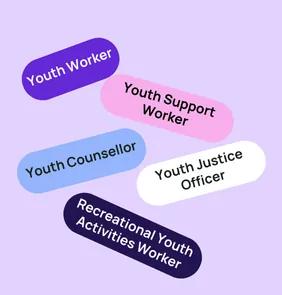
After completing a youth work course, graduates may seek employment in various roles that support and empower young people. Potential positions include working as a:













What do Youth Work graduates do?
Graduates in the youth work industry engage in a variety of roles aimed at supporting young people. Their responsibilities often include:
- Assisting young people in addressing social, emotional, and financial challenges.
- Assessing clients’ needs and developing tailored support plans.
- Implementing educational and training programs to enhance skills and knowledge.
- Monitoring and reporting on the progress of clients to ensure effective support.
- Referring clients to additional services and resources as needed.
In addition to direct support, youth workers often collaborate with other professionals and agencies to create comprehensive support networks. They may also engage in community outreach initiatives to raise awareness about youth issues and promote available services. This collaborative approach ensures that young people receive holistic support tailored to their unique circumstances.
Furthermore, youth workers play a vital role in advocating for the rights and needs of young people within the community. They work to empower youth by providing them with the tools and resources necessary to make informed decisions and take control of their lives. This advocacy extends to addressing systemic issues that impact youth, such as poverty, discrimination, and access to education.
Is Youth Work right for you?
To thrive in the youth work industry, individuals should possess a range of skills, including:
- Strong communication and interpersonal skills
- Empathy and compassion for young people’s challenges
- Problem-solving abilities to address complex situations
- Organisational skills for managing multiple cases
- Ability to work collaboratively with diverse teams
- Understanding of youth development principles
- Resilience and adaptability in challenging environments
- Cultural competence to work with diverse populations
- Knowledge of community resources and support services
- Commitment to ongoing professional development
Job opportunities
The job opportunities for youth workers are diverse and growing, reflecting the increasing recognition of the importance of youth support services. Graduates can find employment in various sectors, including community services, education, and government agencies. The demand for youth workers is particularly strong in areas such as mental health support, juvenile justice, and out-of-home care.
According to recent data, the average salary for youth workers in Australia varies by industry, with community services and development offering competitive remuneration. For instance, youth workers in community services can expect an average salary of around $70,557, while those in government and education sectors earn slightly less, averaging $67,877 and $67,600, respectively.
Frequently Asked Questions
Can I specialise within the youth work sector?
Yes—specialisations include mental health, youth justice, drug and alcohol services, or education support. Many Diploma or Bachelor courses offer elective tracks. Explore specialisation options.
What’s the pathway from youth work into social work or counselling?
Many use their youth work experience to transition into degrees in social work, psychology or counselling. Some programs offer credit transfers.
Is a diploma enough to lead youth programs?
It depends on the employer, but Diploma graduates often lead programs or manage teams in community organisations. Leadership roles may also require experience and additional study.
What government standards apply to youth work?
Youth work roles are guided by the National Framework for Protecting Australia’s Children and various state-based child safety laws. Learn more via DSS.gov.au.
Are youth work qualifications recognised nationally?
Yes—accredited RTOs issue qualifications recognised Australia-wide. Many also align with national training packages listed on training.gov.au.


Disclaimer: Career FAQs Pty Ltd ABN 39 299 617 067 t/a StudySelect markets the education and training services of a range of Australian tertiary course providers, and receives a commission for each prospective student. StudySelect is not an education provider. All material and information regarding our education providers and their courses – on our site, via email, or over the phone – is delivered through our capacity as their agent. The material shared with you on the website is provided as general information only. It is not intended as professional advice, and should not be taken as such. All information is provided in good faith, and is believed to be accurate and current as at the date of publication. However, StudySelect provides no guarantee that any information or material on the website, or linked websites, will be accurate or complete. Please see our privacy policy for more information.