Accredited courses from leading Australian universities, TAFEs and colleges


Qualification Level
Accredited courses from leading Australian universities, TAFEs and colleges



Health administration sits at the core of Australia’s health system. It links clinical care with the records, billing and booking work that keeps services running. It suits people who like structure and enjoy working with health teams. All courses in this field are listed on training.gov.au, the official register of nationally recognised training.
The sector’s size shows its value. Health Care and Social Assistance now employs more than 2.4 million Australians. That makes it the nation’s largest industry by workforce share (Jobs and Skills Australia, 2026). Within it, admin and management roles keep growing as clinics and hospitals update their systems.
Career growth in this field follows a clear path. Many staff start with a certificate III or IV. They then move into practice management through a diploma. Later career stages often bring further study, such as a Master of Health Administration, which opens senior leadership roles.
For anyone who wants a stable career with clear steps forward, health administration offers a real path into healthcare leadership and operations.
Health Administration workers may earn between $55000 and $130000 per year
Entry-level health administration roles, such as medical receptionist and admin officer jobs, tend to pay between $55,000 and $75,000 a year (SEEK Career Advice, 2026). Practice managers earn median weekly pay of $1,655, or around $86,000 a year, per Jobs and Skills Australia (2026). Senior roles, such as hospital operations managers, can reach $120,000 to $130,000 or more with experience.
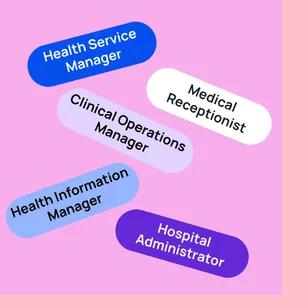
Graduates of a health administration course are well placed for admin and management roles. This spans hospitals, clinics, aged care and allied health services. Potential roles include working as a:
Health administration staff keep hospitals, clinics, aged care and allied health services running well behind the scenes. They pair strong organising skills with a real interest in patient care, working alongside clinical teams rather than treating patients direct.
Typical day-to-day tasks include:
With time and experience, many staff move into practice management or wider operations roles. These roles carry more say over staff, budgets and service planning across a clinic, ward or aged care home.
To thrive in health administration, you will want a mix of order and people skills. Useful traits include:
Job options in health administration are strong and growing. Health Care and Social Assistance added 95,000 workers in the year to February 2026. That is growth of 4.1%, taking the sector to 2.4 million people (Jobs and Skills Australia, 2026).
Roles are open across hospitals, general practice, aged care and allied health clinics in every state. Practice managers earn median weekly pay of $1,655, one of the stronger outcomes in the sector.
Demand is high for admin staff with strong systems and compliance skills, as providers update their records and billing tools. According to PayScale, pay tends to rise with experience and added duties, giving real room for career growth.
A career in health administration blends structure, purpose and real growth. It suits people who want meaningful work in Australia’s largest industry, without needing a clinical degree.
Study paths range from short certificates through to postgraduate degrees. This gives you the choice to start work fast, or build toward a specialist leadership role over time.
The questions below cover common queries about degree options, job security and how to move into health administration from another career.
Options include a bachelor’s degree in health services or a related business degree with a health focus. These suit people who want to lead teams in hospitals, aged care or government health agencies.
Yes. Health Care and Social Assistance is Australia’s largest and fastest-growing industry (Jobs and Skills Australia, 2026). Admin and support roles are growing with it, as services expand to meet rising need.
Yes. Options include a Master of Health Administration or an MBA with a health focus. These prepare experienced staff for policy, planning or senior roles.
Yes, many people do. Staff from retail, hospitality or education often move into health admin. They usually complete a certificate or diploma that adds health-specific rules and knowledge.
With time and further study, you could become a practice manager, hospital operations lead, health policy adviser or consultant. Many roles also sit in government, private hospitals and research groups.