Accredited courses from leading Australian universities, TAFEs and colleges


Qualification Level
Accredited courses from leading Australian universities, TAFEs and colleges



Nursing sits at the heart of Australian healthcare. Registered nurses and midwives together make up more than half of the country’s health workforce (AIHW, 2024), working across hospitals, aged care and community health services. Demand keeps rising as the population ages and health needs grow more complex. Government workforce data shows the number of working nurses grew by more than 36,000 between 2017 and 2022, and this trend looks set to continue (Jobs and Skills Australia, 2023).
Study paths are well set for both main entry points into the profession. Registered nurses usually complete a bachelor’s degree in nursing, while enrolled nurses train through a diploma-level course. Both routes open the door to further study later on, including a Master of Nursing for graduates who want to build deeper clinical expertise. Nurses can build careers in mental health, paediatrics, critical care or midwifery. This wide range of options suits people who want to keep growing their skills throughout their working life.
Pay and conditions in Australian nursing are generally strong, given the weight of the work involved. National rules set by the Nursing and Midwifery Board of Australia keep standards consistent across every state and territory. Several states have also brought in set nurse-to-patient ratios to protect care quality. These ratios give nurses more time to focus on each patient, rather than stretching across an unsafe caseload.
Nursing keeps changing alongside new technology and new models of care, which makes it a genuinely forward-looking career choice. For those who want steady, meaningful work with strong job security, few Australian jobs offer a clearer mix of purpose and opportunity. Ongoing investment in the health system points to further growth in city and regional areas alike.
Nursing workers may earn between $55000 and $150000 per year
According to SEEK career advice data, registered nurses in Australia earn an average of $90,000 to $95,000 a year (SEEK, 2026). Enrolled nurses average $70,000 to $75,000 a year over the same period (SEEK, 2026). Nurse practitioners complete postgraduate study and take on extended clinical authority. They average $145,000 to $155,000 a year (SEEK, 2026). Entry-level pay for enrolled nurses starts lower, closer to minimum rates under the Fair Work Nurses Award. Most nurses earn above these minimums once penalty rates and allowances are included.
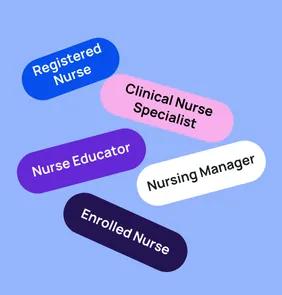
Once you complete a nursing course, a wide range of healthcare settings open up to you. These stretch from busy hospital wards to aged care facilities and community health services. Roles you might move into after graduating include working as a:
Nurses take on a wide range of responsibilities that are central to good patient care. They assess each person’s needs, plan appropriate care, carry out treatment and monitor how patients respond, adjusting their approach as circumstances change. Nurses work closely with doctors, allied health professionals and other members of the care team to coordinate treatment and keep everyone informed.
Beyond direct clinical care, nurses also play a big part in health promotion and education. They take part in community health programs, helping people understand how to manage their health and prevent illness before it starts. Many experienced nurses also mentor newer staff and students, helping shape the next generation of the profession.
Some of the everyday tasks a nurse might carry out include:
Thriving in nursing takes a mix of clinical skill and calm under pressure. The job asks you to stay sharp while still treating each patient as a person, not a task on a list. Look for these strengths in your own approach to work:
The job market for nurses in Australia stays strong, with steady demand across nearly every care setting. Government data shows the number of working nurses grew by more than 36,000 between 2017 and 2022 (Australian Government Health Workforce Data, 2023). This growth looks set to continue as the population ages. Registered nurses are in high demand, and many employers offer good pay and perks to attract skilled staff.
Jobs for nurses turn up across a wide range of settings, including:
Nurses with advanced training, including nurse practitioners, are in growing demand. This holds true in rural and remote areas where access to care can be limited. The Australian Nursing and Midwifery Federation reports steady growth across the field, making this a strong time to build a long-term career in nursing (ANMF, 2026).
Nursing offers a genuinely good path for long-term growth in Australian health care. This field rewards ambition with real progress, whether you are starting your first course or planning a move into advanced work. Registered nurses can build toward specialist roles or step into leadership. Others go on to further study that opens the door to work as a nurse practitioner.
The field also welcomes career changers and people who return to study later in life. Bridging courses, grad certificates and flexible study modes mean there is rarely just one path into nursing. This choice suits people at every career stage. Paired with strong demand across the country, it makes nursing a smart choice for your next move.
Yes. Courses delivered by accredited providers and listed on TEQSA or training.gov.au are nationally recognised and meet AHPRA standards.
Options include Graduate Certificates in mental health, critical care, aged care or public health, plus full Master of Nursing degrees. These courses support career growth and clinical specialisation.
Yes, but they must meet English language requirements and have their qualifications assessed by AHPRA. Bridging programs may also be needed before they can register to practise.
Strong. Government workforce data points to continued growth, especially in aged care and regional healthcare, as demand for skilled nurses keeps rising across the country.
Yes. Clinical nurses work directly with patients, while non-clinical roles include education, policy, research and healthcare coordination. Postgraduate study can open pathways into either direction.